Planning guide
Do you need a tent for an outdoor wedding in Bali?
Last updated 27 October 2026 · AAA Events Group
If your wedding falls between mid-November and late March, book a tent. That is Bali's wet season, and January alone averages about 262 mm of rain over 18 wet days. In the dry months from June to September a tent is optional for rain, but it still gives shade, shelter from the wind and a ceiling for lighting.
Rain is only part of the decision. A clear span tent turns an open lawn into a room, with a clear place for dinner and a frame for the chandeliers. A draped tent goes further and makes a garden feel like a ballroom. AAA Events Group builds both, from our own White Roder and Semi Transparent Roder tents, priced per square metre and installed with the dance floor, stage and furniture. If your venue already has a covered room, the question becomes whether you want guests inside it or outside under a tent.
When is the rainy season in Bali?
Bali has two seasons. The wet season runs from about mid-November to late March. The dry season covers the rest of the year, and June to September is the driest stretch. WeatherSpark's long-term averages for Denpasar put January, the wettest month, at about 262 mm of rain over roughly 18 wet days. August, the driest, gets about 15 mm over 2 wet days.
Source: WeatherSpark long-term averages for Denpasar, converted from inches. Other sources give higher figures, up to about 330 mm for January. Wet season months (mid-November to late March) in blue.
Other sources give higher numbers for the same months, up to about 330 mm for January, so read the chart as the shape of the year and not as a forecast for your date. In January more days are wet than dry, while in August a wet day is rare.
The edges of the season move from year to year. A wedding in early November or late March can be dry or soaked, and El Niño and La Niña years shift when the rains start and how hard they fall. If your date falls in those weeks, plan for rain.
Why do couples book a tent in the dry season too?
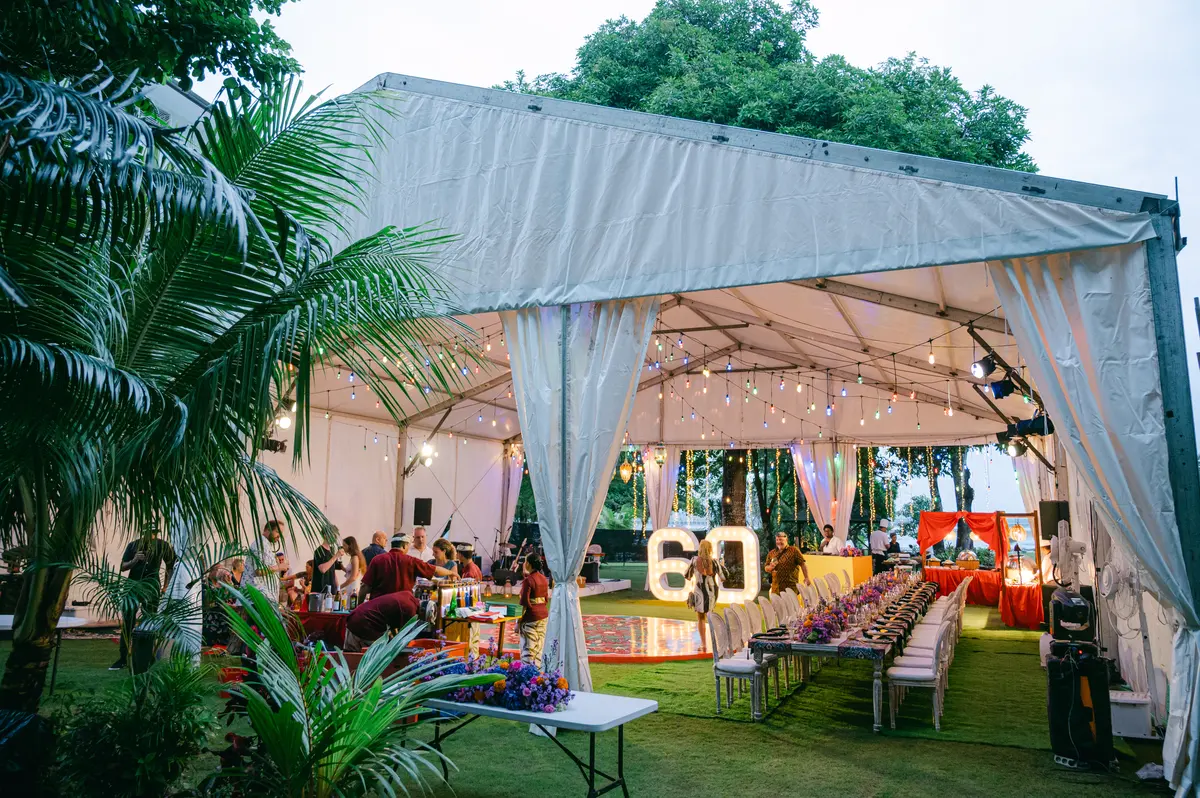
24 of the 61 events in our Past Events used a tent, and 10 of those were between June and September, when it rarely rains.
Rain is only one reason to book a tent. These are the others:
- Shade. A ceremony or a long lunch at two in the afternoon on an open clifftop lawn is hot. A white roof makes it bearable for guests in suits and for the flowers.
- Wind. Clifftop lawns in Uluwatu and Jimbaran face the open sea. Walls on one or two sides keep napkins, candles and florals where the stylist put them.
- A ceiling. Chandeliers, festoon lights, hanging florals and a lighting rig need something to hang from. An open lawn has nothing.
- A room. On a big lawn, a tent shows guests where the party is, and the photos look like a room someone designed.
Which kind of tent should you choose?
Start from how the evening should feel, then pick the roof. These are the four kinds we build:
- Semi-transparent roof. You keep the sky. By day the light comes through, and after dark the chandeliers and festoon lights take over. Our Semi Transparent Roder Tent is the one for this.
- White roof. Even shade and a bright, clean room underneath. The White Roder Tent is our standard for long lunches and daytime receptions.
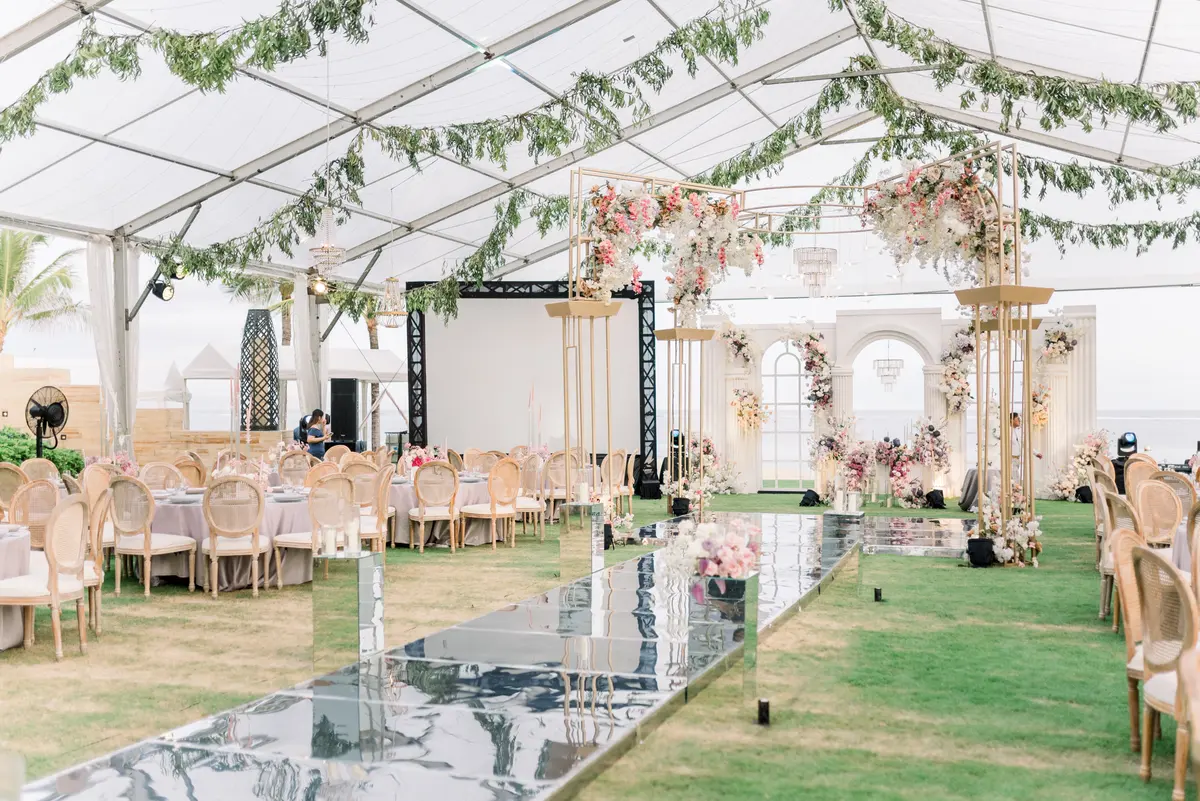
- Draped. Fabric swags inside the frame hide the structure and turn the tent into a ballroom. At Six Senses in December 2024 we built a draped white tent with chandeliers over a glossy white aisle, with the stage facing the sea.
- A statement structure. For one grand room, our Gold Tent Structure is a 10 by 10 metre frame we dress with fabric and florals, made to order for the event.
Our Roder tents are clear span, which means no poles in the middle. Tables, a dance floor and a stage can go anywhere underneath, and nobody's view is blocked.
How much does a tent cost in Bali?
Our tents are priced by area: the White Roder Tent is Rp 180,000 per square metre and the Semi Transparent Roder Tent is Rp 200,000 per square metre. A 10 by 20 metre tent covers 200 square metres, so the structure alone comes to Rp 36,000,000 in white. Delivery, installation and any draping are quoted for your venue.
Size the tent around everything that goes under it. Dinner tables, the dance floor, a bar, a DJ or band and the walkways between them all take space. Send us the guest count and the layout you have in mind and we plan the tent, the floor and the furniture as one layout.
Book the tent when you book everything else. It is the largest build on the day, so it has to be on our plan and on the venue's plan well before the wedding, and it decides where every other piece goes.
What should you tell us to plan the tent?
A tent has to hold more than the tables. Everything that must stay dry or shaded goes under it, and on the night guests also stand, queue at the bar and walk between tables. With these answers we can size it properly the first time:
- The guest count, and seated or standing. A seated dinner needs far more room than cocktails and canapés.
- How dinner is served. Long tables, round tables or a buffet each take a different footprint.
- What else goes under the roof. The dance floor, a stage or band riser, the bar, a lounge corner, the cake table and the DJ.
- Where the ceremony happens. Under the tent, or outside it with guests moving in afterwards.
- The lawn itself. Photos and the venue's site plan, so we can see slopes, trees, paths and the edge of the cliff.
- The look. A clear roof for the stars, white for shade, or draped for a ballroom. A photo of a tent you like is enough.
With that we send back a layout showing the tent, the floor and the furniture together. If the numbers change later, the layout changes with them, so tell us as soon as the guest list moves.
What happens if it rains and you have no tent?
Many hotels have a wet-weather room. Ask what it holds and how late you can make the call to move. A villa often has nowhere for a hundred guests to go, so for a villa wedding in the wet season the tent is the wet-weather plan.
Rain also changes which floor to pick. Mirror, holographic and LED dance floors need cover in wet weather. Timber and melamine cope best in the open. If you decide against a tent, choose the floor with that in mind. Our guide to dance floors on grass covers the outdoor finishes.
What have we built under tents?
Two of our wet-season builds show the range. At The Mulia in December 2023 a clear span tent covered a mirror aisle, with gold floral frames and round tables on both sides. A year later at Six Senses we hung chandeliers in a draped white tent over a glossy white aisle, with a flower-lined stage facing the sea.
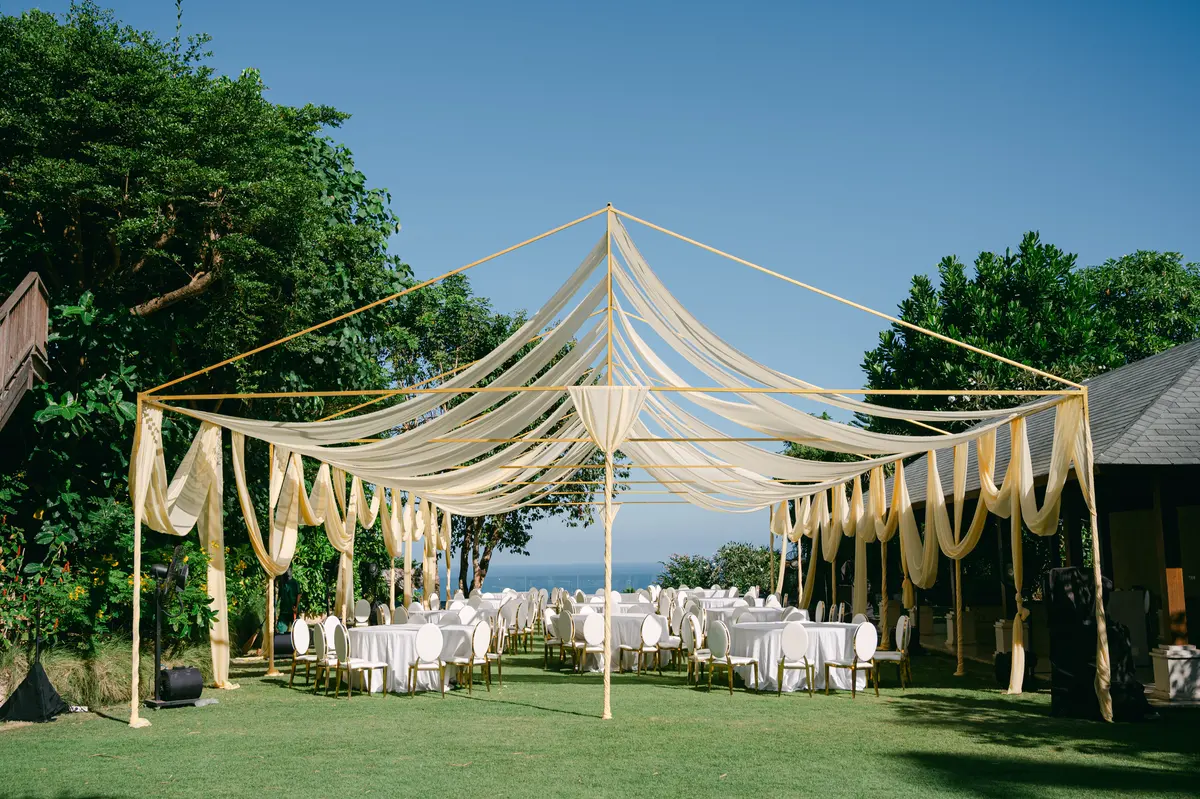
In the dry season the reasons change. At Peninsula in June 2025 the white clear span tent was there for shade and somewhere to gather, with festoon lights, a round patterned floor and lounge seating on the grass. At Pandawa Cliff in June 2026, an open-frame marquee dressed in cream fabric swags sat over the dinner tables with the sea beyond.
You can see these and more in our Past Events. Filter by tent to see only the events with one.
Questions people ask
- When is the rainy season in Bali?
- From about mid-November to late March, with January the wettest month. June to September is the driest part of the year.
- Do I need a tent for a wedding in July or August?
- Not for rain, most years. Many couples still book one for shade during the day, for shelter from the wind on clifftop lawns, and so the lighting and chandeliers have somewhere to hang.
- Can a tent stand on a clifftop lawn?
- Yes. Many of the tents in our Past Events stand on clifftop lawns, at Sky Ayana and Pandawa Cliff among others.
- How is a tent priced?
- Per square metre of tent. Delivery, installation and any draping are quoted for your venue. Message us the guest count and layout and we reply with the size and the price.
- Can you supply the dance floor and furniture under the tent?
- Yes. We build the tent, the dance floor, the stage and the furniture as one job, so the sizes fit and one team is responsible on the day.